
Strong chess champions use other parts of their brain as normal club players. This was researched and established at the university in Konstanz, Germany.
They proved that chess masters mostly rely on their memory while normal amateur players use other parts of their brain that have the task of judging and analyzing new situations. Chess masters with higher Elo Rating used more often their memory banks than masters with lower rating.
The process to remember is faster compared to judging, analyzing and pondering. This explains why a master is much quicker coming up with a good move as he relies on his memory banks where he has stored thousands of chess ideas, chess variations and chess positions from his past games. Whereas the amateur player is always confronted with a new position which he has to analyze and judge again from scratch. This takes a lot of time.
This leads to the conclusion that people, who have a photographic memory should be able to store a lot more chess ideas than normal people. If this is so, only people with excellent memory can become chess champions because this natural advantage (for example: photographic memory) can not be overcome with training. They all do training but only some of them have the abilities to become great players.
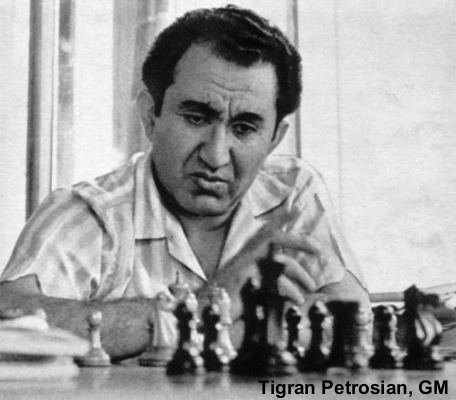
Former world chess champion, Tigran Petrosian
Classical World Champions
| Name | Year | Country | Age | |
|---|---|---|---|---|
| 1 | 1886–1894 | Austria-Hungary/United States | 50–58 | |
| 2 | Emanuel Lasker | 1894–1921 | Germany | 26–53 |
| 3 | 1921–1927 | Cuba | 33–39 | |
| 4 | 1927–1935 1937–1946 |
Russia | 35–43 45–54 |
|
| 5 | Max Euwe | 1935–1937 | 34–36 | |
| 6 | Mikhail Botvinnik | 1948–1957 1958–1960 1961–1963 |
Soviet Union/Russia | 37–46 47–49 50–52 |
| 7 | Vasily Smyslov | 1957–1958 | Russia | 36 |
| 8 | 1960–1961 | Latvia | 24 | |
| 9 | Tigran Petrosian | 1963–1969 | Soviet Union/Armenia | 34–40 |
| 10 | Boris Spassky | 1969–1972 | Soviet Union/Russia | 32–35 |
| 11 | 1972–1975 | United States | 29–32 | |
| 12 | Anatoly Karpov | 1975–1985 | Soviet Union/Russia | 24–34 |
| 13 | 1985–2000 | Soviet Union/Russia | 22–30 | |
| 14 | Vladimir Kramnik | 2000–2006 | Russia | 31 |
Chess-Playing Robot – The Mechanical Turk
Chess-Champions
FIDE World Champions 1993–2006
| Name | Year | Country | Approx. Age | |
|---|---|---|---|---|
| 13 | Anatoly Karpov | 1993–1999 | Russia | 42–48 |
| 14 | Alexander Khalifman | 1999–2000 | Russia | 33 |
| 15 | 2000–2002 | India | 31–33 | |
| 16 | Ruslan Ponomariov | 2002–2004 | Ukraine | 19–21 |
| 17 | Rustam Kasimdzhanov | 2004–2005 | Uzbekistan | 25 |
| 18 | Veselin Topalov | 2005–2006 | Bulgaria | 30 |
World Champions 2006–present
| Name | Year | Country | Approx. Age | |
|---|---|---|---|---|
| 19/14 | Vladimir Kramnik | 2006–2007 | Russia | 31 |
| 15 | 2007–present | India | 38 |
Read more about World Chess Championships and Chess Matches in History!
Chess Grandmasters and Chess Kids
Go from – Chess Champions – to Chess Strategies – Home
 Sick of Losing at Chess? Get Chess Courses from a Grandmaster directly! HUGE Discount! Click here!
Get Chess Course -Beginners Package- from a Grandmaster! Huge Discount!